Choosing Technology for a Luxury Home: Why the Product Is Only Part of the Decision

There is no shortage of impressive technology available for a luxury home.
The challenge is deciding which technology actually belongs there.
At Audio Command Systems (ACS), that question rarely begins with a model number. It begins with the people who will live in the home, the experience they want, the architecture surrounding them, and the many systems that eventually have to work together.
That distinction matters. On a sophisticated residential project, an individual product can be excellent on its own and still not be the right choice for the larger system.
A sophisticated ACS project can involve products from dozens of different manufacturers. Each may solve a particular need exceptionally well, but the larger challenge is determining how those individual technologies belong together within one home.
The challenge isn't simply finding good equipment.
It's knowing how to bring the right equipment together.
A Luxury Home Is a System, Not a Collection of Products
It is easy to shop for technology one category at a time.
Find a highly rated television. Choose premium speakers. Select a lighting control platform. Add top networking equipment, motorized shades, security, climate control, and other connected systems as the project develops.
Individually, every choice may look perfectly reasonable.
But that isn't how an integrated home ultimately operates.
The homeowner doesn't experience 50 individual manufacturers. They experience one home.
Press a button, and the room responds. Select a source, and the entertainment system comes alive. Lighting, shades, climate, audio, video, networking, and control should feel as though they were designed as parts of the same environment.
Creating that experience requires a different way of thinking about product selection.
For ACS, the question is not simply, "Is this a good product?"
It is also: Is this the right product for this project?
Those are very different questions.
The "Best" Product Depends on What You Are Trying To Accomplish
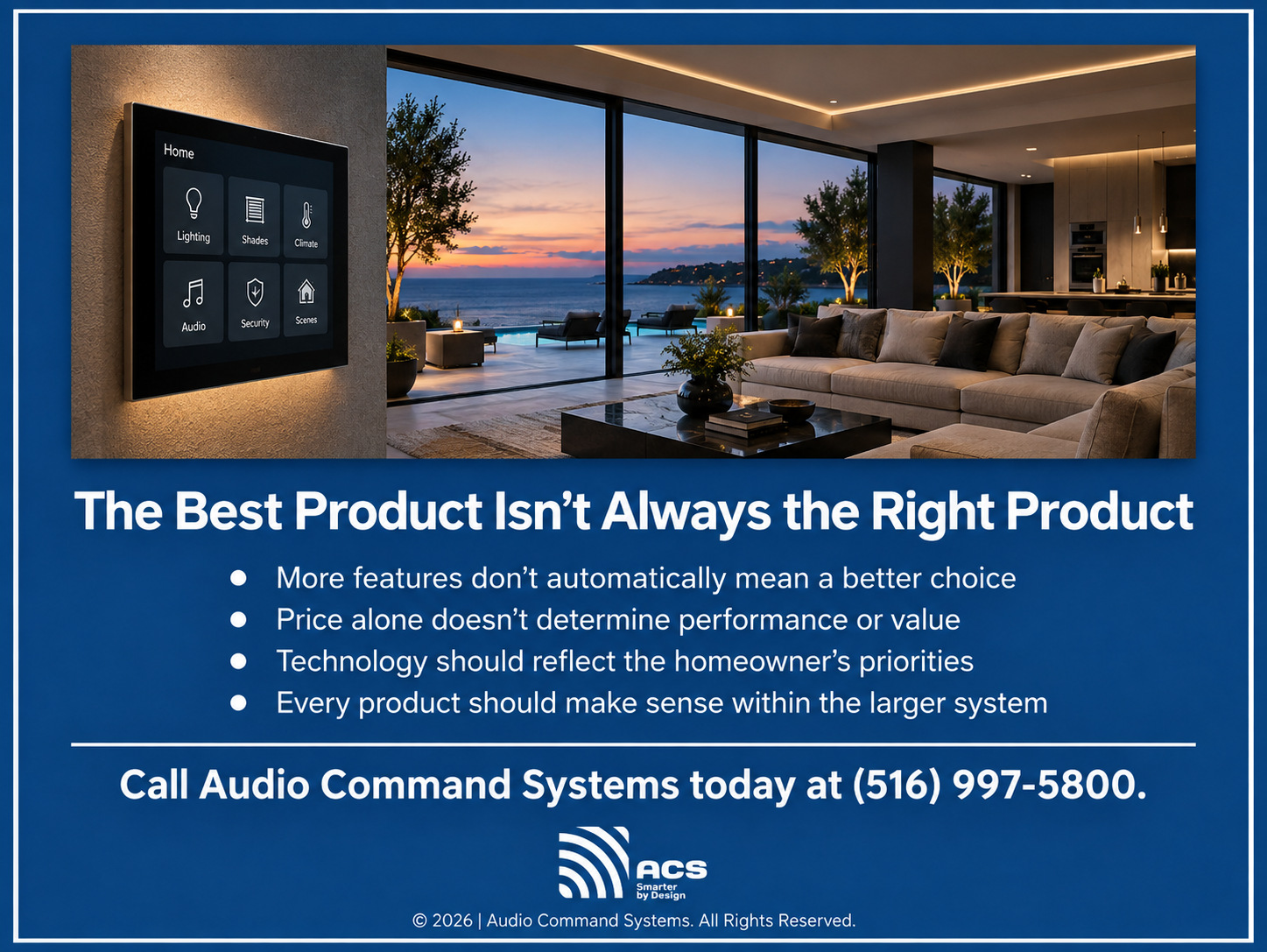
Luxury technology comes with an enormous range of choices, and price alone doesn't settle the question.
Consider a common example from the AV world. Why would someone choose a dedicated premium movie platform when a much less expensive streaming device can also put movies on a television?
There can be legitimate reasons. Performance, quality, experience, design priorities, and client expectations can all change the answer.
The same principle appears throughout the home.
A product with more features isn't automatically a better selection. Neither is the most expensive option or the newest product to reach the market.
At ACS, we use a proven process for advanced home integration and automation—spending considerable time evaluating technology, including products the company may never ultimately recommend. Understanding what is emerging, what is mostly marketing, and what represents a meaningful change is part of advising clients and project teams well.
That becomes particularly important in luxury residences, where the goal isn't to fill the home with technology for technology's sake.
The goal is to make deliberate choices that support how the homeowner wants to live.
Product Selection Also Means Evaluating the Company Behind It
Specifications tell you a great deal about a product.
They don't necessarily tell you what it will be like to build around that product, integrate it with other systems, or rely on the manufacturer over time.
That knowledge comes from experience. ACS partners with only the best—ensuring top performance with industry-leading manufacturers.
Long-term familiarity with manufacturers gives the ACS team insight that extends beyond a particular device. Over time, we develop an understanding of a manufacturer's philosophy, how seriously it approaches product development, how its products behave in real projects, and whether the substance behind the technology lives up to the marketing surrounding it.
For an architect, designer, builder, or homeowner, much of that evaluation happens behind the scenes.
And that's appropriate.
A project team shouldn't have to become an expert on every technology manufacturer involved in the residence. The integrator should bring that knowledge to the table and translate it into decisions the rest of the team can use.
Integration Is an Exercise in Compatibility and Judgment
The complexity becomes clearer when dozens of individual decisions start intersecting.
A residential technology system may involve many different manufacturers across multiple categories. Each manufacturer develops products according to its own standards, priorities, and roadmap.
ACS has to consider how those choices behave together. The goal is luxury smart home integration for effortless living.
The right chemistry must exist among products and manufacturers to achieve that goal.
A successful system is not simply a list of premium ingredients.
The combination matters.
That judgment is built over years of designing systems, working with manufacturers, watching technologies evolve, and seeing how products perform in actual homes.
It is also why experience becomes difficult to replace with a specification sheet.
The Right Recommendation Sometimes Costs Less
Good technology advice has another side that can be easy to overlook in luxury projects.
Sometimes the right recommendation is not the more expensive product.
Consider an extremely high-end audio product whose price reflects not only performance, but exotic materials, craftsmanship, and its value as a design object.
For a client who values those qualities, the premium may be entirely worthwhile. For someone interested strictly in audio performance, another solution at a fraction of the price may be the better recommendation.
That distinction gets to the heart of the integrator's role.
The job isn't to maximize the price of every component. It's to understand what matters to the client and recommend accordingly.
On another project, the answer might go in the opposite direction. A substantially more expensive audio system may genuinely create the experience a particular homeowner is looking for.
Neither recommendation is inherently right.
The expertise lies in knowing the difference.
Architects and Designers Shouldn't Have To Become Technology Experts
This distinction matters to the professionals responsible for the larger vision of the home.
An architect needs to understand how technology affects the architecture.
An interior designer needs to know how it interacts with finishes, furnishings, lighting, and a room’s visual language.
A builder needs accurate information so technology can be coordinated with the larger construction process.
None of them should have to spend their time comparing dozens of nearly identical product specifications.
The integrator's role is to bring technical depth to those conversations without letting the technology overwhelm them.
That requires another skill beyond technical knowledge: knowing how to translate complex information into a level that is useful to the person sitting across the table.
That's an important distinction.
Expertise has limited value if nobody else on the project can use it.
Experience Helps the Team Look Beyond Today's Technology
Another reason product selection requires a broader view is that technology doesn't stand still.
The way homeowners interact with their systems has changed dramatically over time. Interfaces get simpler. Capabilities that once required separate devices become built into other products. New technologies arrive with enormous attention, while others quietly become everyday standards.
ACS evaluates those shifts as part of its technology planning.
The objective isn't to predict every product that will exist five years from now. Nobody can.
Instead, we use firsthand knowledge of current technology, combined with experience watching previous generations of technology evolve, to make thoughtful decisions about the home being designed today.
For project teams, that perspective can influence decisions long before equipment orders are placed.
The Finished Experience Is the Real Product
Most ACS clients don't begin the conversation with a specific string of model numbers.
They describe what they want technology to do for them.
They want music to create a particular feeling. They want entertainment to be effortless. They want controls that make sense. They want technology to complement the home rather than compete with it.
From there, ACS works backward.
Which products support that experience? Which manufacturers make sense? How should the systems connect? What does the architect need to accommodate? What does the designer need to know? What infrastructure should the builder incorporate into the project?
The equipment matters enormously.
But the equipment is still a means to an end.
For ACS, the finished product is the experience created when all of those individual decisions finally disappear into the home.
That is why the best time to involve a technology integrator is not after every product decision has already been made. The power of early collaboration gives ACS, the architect, designer, builder, and homeowner room to consider technology as part of the larger project rather than as a collection of devices added near the end.
If you're planning a new residence or major renovation, connect with the ACS team early in the process. The conversation doesn't need to begin with products. It can begin with a much more useful question: How do you want the home to work for the people who will live there?


